Sonar Instrument Definitions
NOTE: Cakewalk Instrument Definition Files are available for the Yamaha MIDI instruments listed above. The download link is provided below. If an instrument definition is not available for your Yamaha MIDI instrument, contact Cakewalk for information on how to create a custom instrument definition. Instrument definitions. Instrument definitions are a powerful feature of SONAR that makes it easier for you to find the banks, patches, and controllers of your MIDI instruments. An instrument definition is a file that contains the names of the banks, patches, note names, bank select method, and controllers of an instrument.
Also found in: Thesaurus, Medical, Acronyms, Encyclopedia, Wikipedia.so·nar
(sō′när′)n.sonar
(ˈsəʊnɑː) n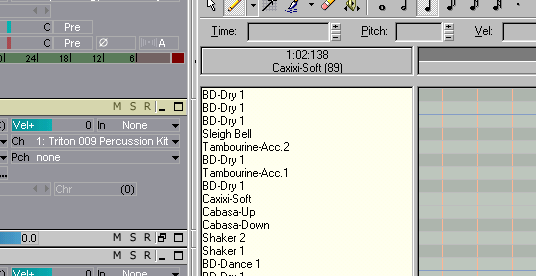

so•nar
(ˈsoʊ nɑr)n.
so·nar
(sō′när′)sonar
| Noun | 1. | sonar - a measuring instrument that sends out an acoustic pulse in water and measures distances in terms of the time for the echo of the pulse to return; 'sonar is an acronym for sound navigation ranging'; 'asdic is an acronym for antisubmarine detection investigation committee' asdic, echo sounder measuring device, measuring instrument, measuring system - instrument that shows the extent or amount or quantity or degree of something navigational instrument - an instrument used for navigating pinger - a pulse generator used for echo sounding in sonar pulse generator - a generator of single or multiple voltage pulses; usually adjustable for pulse rate pigboat, submarine, U-boat, sub - a submersible warship usually armed with torpedoes |
sonar
[ˈsəʊnɑːr]n → sonarmsonar
sonar
[ˈsəʊnɑːʳ]n → sonarm invWant to thank TFD for its existence? Tell a friend about us, add a link to this page, or visit the webmaster's page for free fun content.
Instrument Definitions For Sonar
Link to this page:How To Create or Modify an Instrument Definition
Instrument Definitions are very convenient, because they allow you to choose your MIDI gear’s banks and patches from within your Cakewalk product, rather than on the device itself. If you find we don’t currently offer the definition for your MIDI device, you may want to create the definition yourself. These instructions will direct you in that task.
The Define Instruments menu
Choose Options Instruments and click the Define button to view the Define Instruments menu. The Instruments tree, in the left pane, shows the instrument definitions currently loaded in your Cakewalk product. The Names tree, in the right pane, shows the resources you use to build the instrument definitions. This is where you’ll begin the construction of your Instrument Definition.
Create a Patch Name List
1. Right-click the Patch Names folder in the Names tree
2. Select Add Patch Names List
3. Type the Name of your new patch list
Entering Patch Names
1. Right-click your new Patch Name list
2. Select Add Patch Name
3. Type the name of the first patch after the “0=”, then press
4. You can enter the data for specific patch numbers if you use the format NUMBER = NAME. For Example type: 100 = Xylophone then press
5. Use the
Create New Instrument
1. Push
2. Type your new instrument’s name
Assigning Your Patch Name Lists to the New Instrument
1. Drag your Patch Name List(s) and Drop it on your new Instrument
2. Enter the Bank Number. If you need help determining the correct Bank Number, see below in this article.
Modify Bank Select Method
1. Open the Bank Select Method folder in the Names Tree. If you aren’t sure what BSM to select, check your keyboard manual.
2. Drag and Drop the correct Bank Select method from the Names Tree on the BSM in your new Instrument. Your keyboard manual should specify whether the instrument uses the Normal method (Controllers 0 and 32), or another method.
————————————————————-
Bank Select Methods Made Easy
Synthesizer manufacturers will provide different methods for changing banks via MIDI. Some manufacturers use a simple patch change message to change banks, while others use a MIDI Controller 32 message, or a Controller 0 message. Some MIDI instruments use a combination of Controller 0 and Controller 32; this last method is also known as the Normal Bank Select method.
This document addresses the four different Bank Select methods used in Cakewalk’s Tools, Instruments, Define menu. First, we’ll look at the Normal Bank Select method.
Determining the Correct Bank Number – Normal Bank Select Method (Ctl 0 and Ctl 32)
You will have to do some calculations to determine the correct “Normal” bank numbers to use in Cakewalk. The good news is that Cakewalk will save the bank numbers as part of your Instrument Definition.
For this example, let’s determine correct Bank Number for the Preset A bank of the Roland JV-1080 synthesizer. The JV-1080 uses the Normal Bank Select method.
For synths using the Normal Bank Select method, you need to calculate the bank number based on the values of Controller 0 and Controller 32. There’s a simple formula for doing this. The formula works for all instruments that use the Normal Bank Select Method of Controller 0 and 32:
(Ctrl 0 value x 128) + Ctrl 32 value = Bank number
NOTE: Some Synthesizer manufacturers refer to Controller 0 as the MSB, or Most Significant Byte, and to Controller 32 as the LSB, or Least Significant Byte.
According to Roland’s documentation, the JV-1080 PR-A Bank has a Controller 0 value of 81, and a Controller 32 value of 0. Plug these numbers into the formula:
(81 x 128) + 0 = 10368
So 10368 is the correct bank number for the PR-A Bank. Use this formula to calculate the correct numbers to enter in the Instrument Definition walkthrough above.
Determining the Correct Bank Number – Other Bank Select Methods
Some synthesizers, such as many Ensoniq and Kurzweil models, use a patch change event (also known as a program change) to change banks. Keyboards manufactured by Roland, Korg, and E-mu can use any combination of Controller 0 Only, Controller 32 Only or Normal (Controller 0 & Controller 32). This information is usually located in the back of the synth’s Users Guide in the “MIDI Implementation Chart.” Consult the keyboard manufacturer for further information.
Controller 0 Only
When using Controller 0 Only, simply type the value of the Controller 0 into the Add Patch Names Bank Number window.
An example of this is the Roland JV-80. It uses a Controller 0 value of 81 to change between A and B banks. Type 81 in the Bank Number window that appears after you drag & drop Patch Name List onto the Patch Name for Banks folder.
Controller 32 Only
If your synth uses Controller 32 only, type the Controller 32 value into the Bank Number window and associate that number with the patch list you created earlier.
Patch 100..127
If your instrument accesses its banks via patch events, you will select Patch 100..127 in the Bank Select Method window. Remember that the actual patch number used to change banks will be offset by 100 when you type the number into the Bank Number window. For example, certain Ensoniq keyboards use a patch change number of 124 to change to a specific bank. Instead of typing 124 into the Bank Number window, you will type 24. Associate the number 24 with the patch list you created in the Uses The Patch Names menu.
When you need help, Sweetwater has the answers!
Our knowledge base contains over 28,000 expertly written tech articles that will give you answers and help you get the most out of your gear. Our pro musicians and gear experts update content daily to keep you informed and on your way. Best of all, it’s totally FREE, and it’s just another reason that you get more at Sweetwater.com.